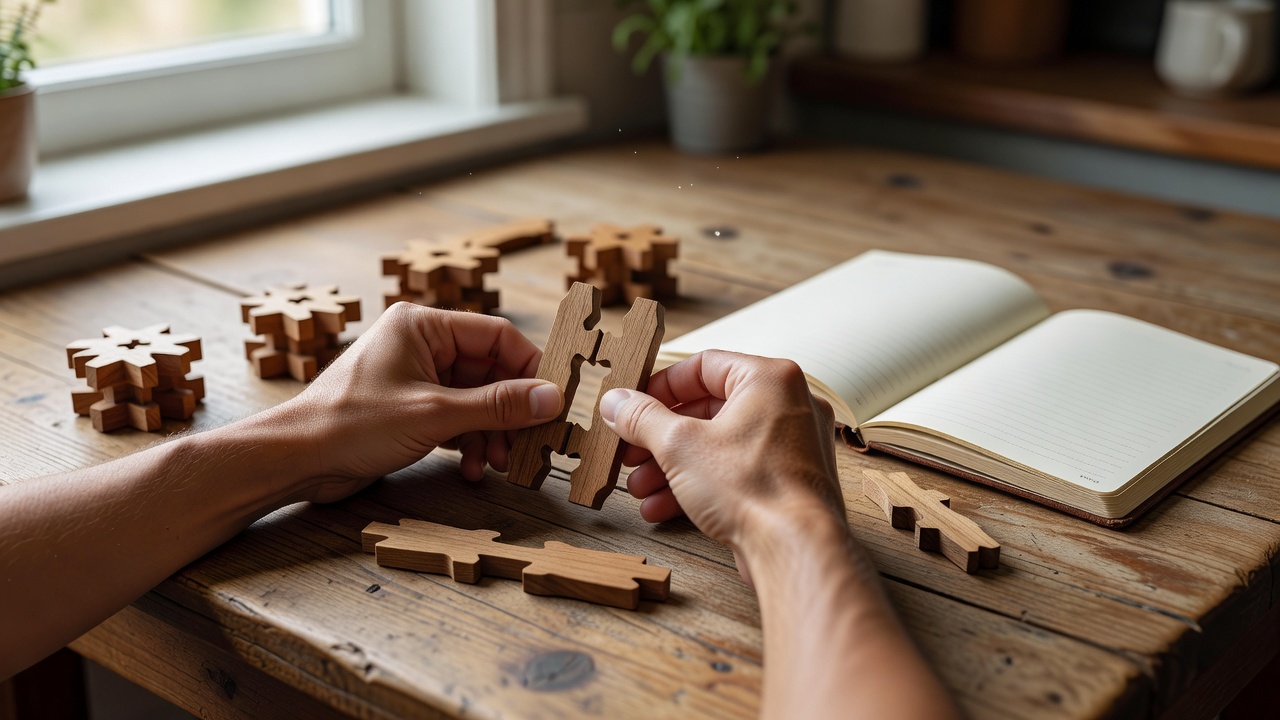
Warm, light and quietly precise
Wood changes the mood of a puzzle. Where metal is cool and dense, a block of maple or walnut is warm almost immediately, and its weight is modest enough that you can rotate an assembled cube in one hand while probing it with the other. Pieces slide with a soft whisper rather than a clink. Well-made wooden puzzles have tolerances you can feel: a piece that glides without wobbling, a joint that seats with a faint, satisfying stop.
That precision is also why wooden puzzles invite slower handling. You feel the difference between a piece that is blocked and one that is simply snug. Learning to read that difference — friction versus geometry — is most of the early skill.
- WeightLight; easy to turn over and inspect from all sides.
- SurfaceOiled or waxed finishes feel silky; raw wood feels drier.
- FitTight tolerances glide; loose ones rattle and mislead.
- ClimateHumidity can swell wood and stiffen movement.
Burrs, packings and boxes
Burr puzzles are interlocking assemblies of notched sticks. The classic six-piece burr looks like a three-dimensional cross, and its internal notches are invisible once assembled. In the 1980s the American mathematician Bill Cutler used computer analysis to catalogue six-piece burr configurations, showing just how many variations a simple outline can hide. Some burrs need several moves before the first piece comes free; that number is sometimes called the level.
Packing and assembly puzzles ask you to fit shapes into a box or build a target form. The American designer Stewart Coffin, whose book The Puzzling World of Polyhedral Dissections remains a reference for enthusiasts, created many geometric wooden designs whose beauty lies in how few pieces they need.
Secret boxes hide their opening sequence. The Japanese tradition of Hakone puzzle boxes, often decorated with yosegi-zaiku marquetry, uses sliding panels; contemporary craftsmen such as Akio Kamei and the Karakuri Creation Group have extended the form with playful hidden mechanisms.
| Form | Pieces | Main action | Reset behaviour |
|---|---|---|---|
| Six-piece burr | Six notched sticks | Sliding in sequence, then lifting | Reassembly needs the order reversed |
| Packing puzzle | Several shapes plus a tray or box | Rotating and placing | Tip out and start again |
| Polyhedral assembly | Identical or near-identical pieces | Building a symmetrical form | Often easy to scatter, hard to rebuild |
| Secret box | One object, hidden panels | Pressing, sliding, discovering | Closing reverses the panel sequence |
Give the pieces a home
The most common way to lose a wooden puzzle is not to fail at it but to drop a piece behind the radiator. A shallow tray, a baking sheet or the lid of a shoebox keeps everything within reach. When you take an assembly apart, lay pieces out in the order they came free and in the orientation they had. A quick phone photo at each stage is a perfectly respectable memory aid.
Wood responds to its environment. In a humid room, a puzzle that slid freely in winter may stiffen; in a dry, heated office, joints can loosen. Never sand or force a sticking piece — let it acclimatise for a day. A tiny amount of paste wax on a stiff contact surface is the traditional remedy, applied sparingly.
“When a wooden piece resists, ask first whether it is blocked or merely snug.”
Narrow the search, keep the discovery
GentleStarting a burr you cannot open
Try every stick in every direction, gently. Often only one piece moves at all, and only a few millimetres. That small movement is the beginning of the sequence.
SpoilerWhen a packing puzzle almost fits
If you are left with a gap of exactly one piece-shape, the problem is usually the first two pieces placed, not the last. Some packings also rely on a piece standing on its edge rather than lying flat.
SpoilerSecret box with no visible seams
Hakone-style boxes often begin with a panel on a short side moving only a fraction of a centimetre. Press firmly but gently along each edge before assuming the top must lift.
Match the wood to your patience
If you like a clear target and loose pieces, start with a packing puzzle. If you enjoy the sense of something locked tight, a burr suits you; low-level burrs open quickly and still teach the language of interlocking. If you prefer exploration over logic, a secret box gives you discovery without much setup. None of these needs to be rare or expensive to be satisfying.
For puzzles that keep their mechanism in a single sealed object, see desk mechanisms, or compare the cooler logic of metal puzzles.