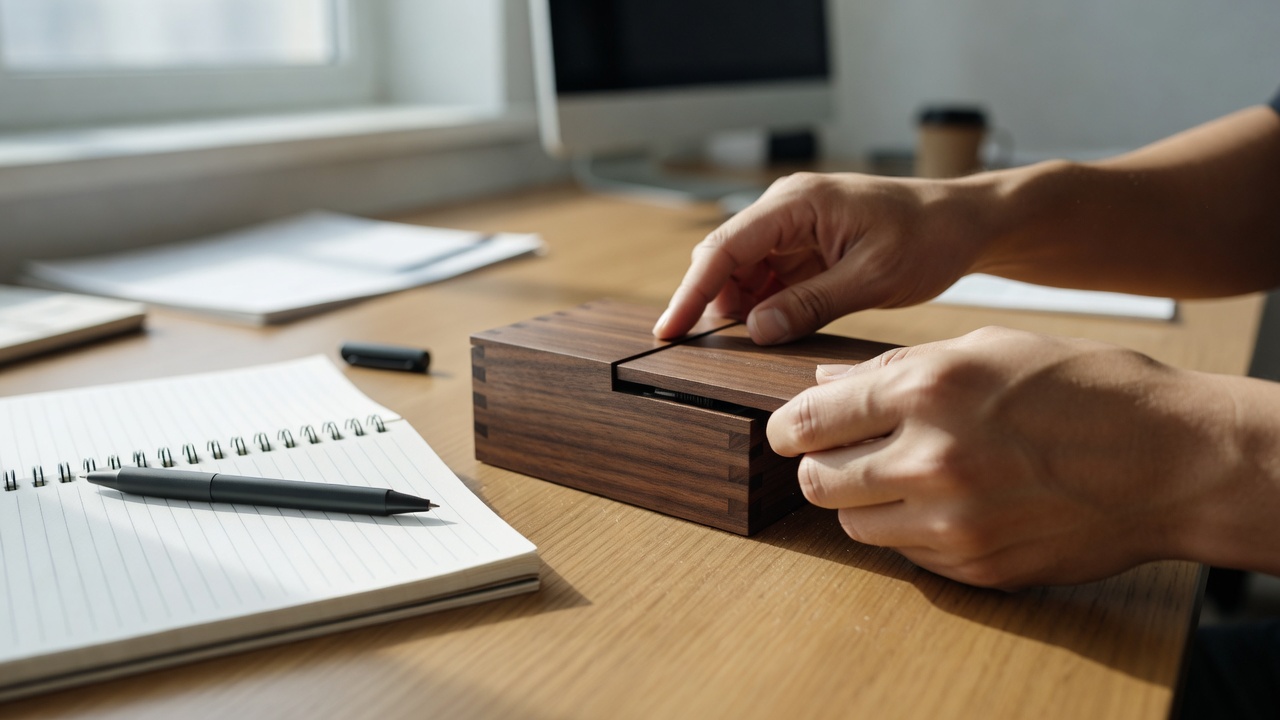
Probing, pressing, listening
Mechanical desk puzzles are the ones that look like something else. A pen holder that will not release its drawer. A small chest with no visible lid. A stack of discs on three pegs that seems to explain itself, until you try. Handling them is exploratory: you press corners, turn the object over, listen for a sliding weight, feel for a panel that gives by a millimetre.
This is the form most likely to stay on your desk as an object in its own right. It invites people passing by to pick it up, which makes it a sociable puzzle — and a reason to remember where you left it in its sequence.
- WeightVaries widely; internal weights can shift as you tilt.
- MovementPressing, sliding, rotating, sometimes using a found tool.
- SoundClicks and rattles are often deliberate clues.
- ResetFrequently means reversing every discovered step.
Sequences, states and hidden locks
Puzzle boxes lock their opening behind a sequence of moves, often descending from the Japanese Hakone tradition. Sequential discovery puzzles go further: you find small tools inside the object — a pin, a key, a magnet — and must use them to progress. Designers showcase this genre at gatherings like the International Puzzle Party, where the associated Nob Yoshigahara Puzzle Design Competition, named after the influential Japanese puzzle creator, presents new mechanical ideas each year.
State puzzles keep their mechanism in plain sight. The Tower of Hanoi, published by the French mathematician Édouard Lucas in 1883, asks you to move a stack of discs between pegs without placing a larger disc on a smaller one. Twisty puzzles, the family made famous by Ernő Rubik's cube in the 1970s, are compact desk companions whose challenge is entirely in the order of turns.
| Type | What you do | What is hidden | Reset behaviour |
|---|---|---|---|
| Puzzle box | Slide and press panels | The sequence and the seams | Close by reversing steps |
| Sequential discovery | Find and use internal tools | Tools, locks and their order | Can be lengthy; follow designer's notes |
| Tower-style state puzzle | Move pieces under a rule | Nothing; the challenge is planning | Simple to restack |
| Twisty puzzle | Rotate layers | Nothing; order of moves matters | Hard by hand once scrambled |
Respect the mechanism
Hidden mechanisms are more delicate than they look. Internal pins and springs are small, and a box opened by force may never close properly again. If you are stuck, change what you are doing rather than how hard you are doing it: tilt, tap gently on the desk, rotate a quarter turn, try a different face. Many sequential puzzles include a designer's reset note; keep it somewhere safe, perhaps taped inside a desk drawer.
For twisty puzzles, the constraint flips. Nothing breaks easily, but a scrambled state can feel like a wall. Learning a beginner's layer-by-layer method is a perfectly fair way to enjoy the object and does not spoil the pleasure of turning it.
“A click you did not expect is never just noise. Stop and repeat the last move.”
Clues the object is already giving
GentleA box that will not do anything
Listen while you tilt it slowly through each axis. A moving internal weight tells you a gravity lock is present, and roughly where.
SpoilerSequential discovery habits
Anything that comes loose is probably a tool. Before using it elsewhere, check whether it fits back into the place it came from in a different orientation.
SpoilerTower of Hanoi pattern
The smallest disc moves on every other turn, always cycling in the same direction around the pegs. With that rhythm, the remaining moves are forced.
Choose the secret you want to live with
If you like objects that look ordinary, a puzzle box gives you discovery and a handsome desk ornament. If you enjoy a story of tools and locks, sequential puzzles are rich but ask for care. If you want something durable to pick up a hundred times, a state or twisty puzzle is the sensible choice. Let your appetite for exploration decide, not a scale on the box.
For forms you can carry anywhere, see pocket mazes; for traditional craft, read wooden challenges.